How to build a realistic travel itinerary: the checklist version
 By Leo Morgan
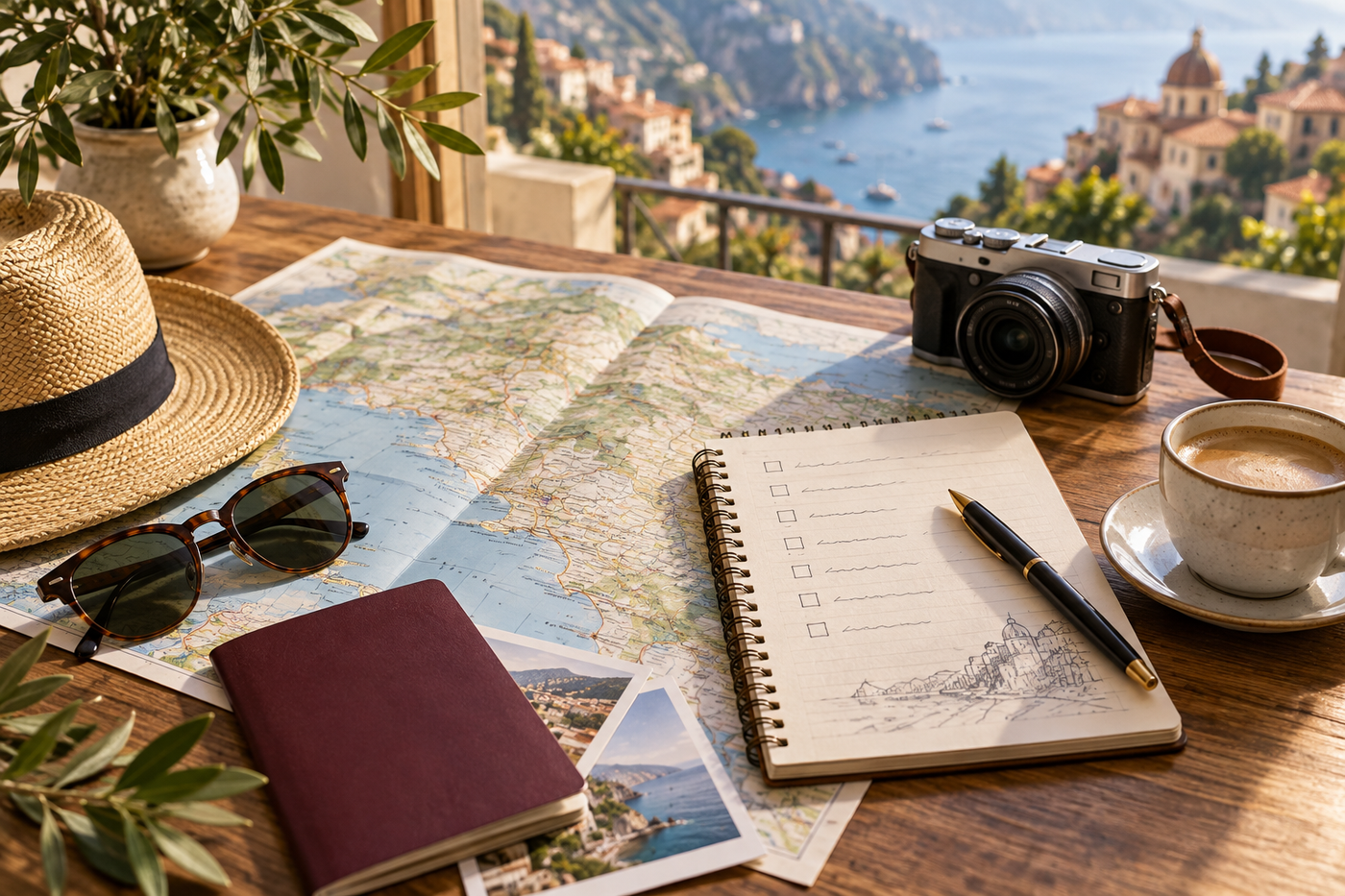
A realistic itinerary gives each day a shape without turning your holiday into a race. Use this checklist to balance sights, meals, transport, rest, and backup plans before you leave.
Start with the trip you actually want
A good itinerary begins with an honest description of the trip, not a list of every attraction in a guidebook. Decide whether the priority is food, museums, beaches, hiking, nightlife, time with family, or simply getting to know one neighbourhood slowly. That choice gives you a filter for every later decision.
Write down two or three outcomes that would make the trip feel successful. For example, you might want to eat well, see a few major landmarks, and have unhurried mornings. This keeps the plan useful when an opening hour, weather change, or tired travel companion forces a choice.

Your trip deserves fewer tabs.
Start planning your tripChoose a small number of daily anchors
Anchors are the appointments or experiences that give a day direction. They might be a timed museum entry, a market that is only open in the morning, a hike with a fixed start, or dinner at a restaurant you care about. Most days need one major anchor and perhaps one smaller one.
Put anchors on the calendar first, then build around them. If three reservations are already fixed, the day is not a blank canvas. Leave the spaces between them open enough for walking, queues, photographs, and the ordinary pauses that make a trip feel like a trip.
Give each day a realistic pace
Count travel time and human energy, not just the number of places. A morning attraction, a long cross-city journey, and an evening show may look possible on a map, yet the combination can produce a day that feels rushed from breakfast onward. Most travelers enjoy a plan more when it has a clear high point and a lower-pressure second half.
Use a simple rhythm: one demanding activity, one flexible activity, and a period with no obligation. On a longer trip, alternate fuller days with lighter ones. A rest day does not need to mean staying indoors. It can be a neighbourhood walk, a long lunch, or an afternoon beside the hotel.
Group the map before you book anything
Map grouping is one of the easiest ways to remove unnecessary friction. Mark the places that matter, then look for clusters rather than drawing a route that zigzags across the city. A cluster can be a historic centre, a waterfront, a museum district, or several villages connected by one train line.
Keep each day geographically coherent, but do not confuse a neat map with a good experience. A single exceptional place can justify a longer journey. When it does, make the journey part of the day and reduce the number of additional stops around it.
Once your clusters are clear, use Holihopper to save places to a travelboard and see them together on the map, so the practical shape of the plan stays visible while you make choices.
Plan meals without scheduling every bite
Meals are part of the route, and ignoring them creates avoidable detours. Check where breakfast is easy, where lunch fits naturally, and which dinners need a reservation. A restaurant on the other side of town can turn a pleasant afternoon into a race, especially when public transport is busy.
Make one or two meals deliberate each day and leave the rest flexible. Save a short list of nearby alternatives for different energy levels and budgets. Also check local opening patterns. A famous market may be best before lunch, while a small restaurant may close between services or on a regular weekday.

Turn your travel ideas into a plan.
Start planning your tripPrice the time between places
Transport time is more than the published journey duration. Add the walk to the station, time to find a platform, transfer uncertainty, ticket collection, and the possibility of a missed connection. In a large city, getting across town at rush hour can be a meaningful activity in itself.
For every important move, note the simplest option, the likely duration, and one alternative. If the route depends on a last train or a tight airport transfer, make that dependency visible. The plan becomes calmer when you know which timings are essential and which are merely convenient.
Add buffer time on purpose
Buffer is not wasted space. It absorbs a slow breakfast, a wrong turn, a queue, a rain shower, a delayed train, or the discovery of a street you want to explore. Without it, every small surprise pushes through the rest of the day.
Leave more buffer around airports, ferries, timed tickets, and activities that require energy or equipment. Within a normal sightseeing day, a free hour before dinner is often enough to make the schedule feel flexible. If you are traveling with children, older relatives, or a group, increase the allowance rather than hoping everyone will move at the fastest possible pace.
Separate fixed plans from nice-to-have ideas
Create two lists. The first contains things that must be booked or completed, such as accommodation, transport, timed entries, and a few high-demand meals. The second contains ideas that can happen if the weather, mood, and timing cooperate.
This distinction protects the trip from overbooking. A flexible idea should not carry the emotional weight of a reservation. It is there to help you choose when you have spare energy, not to make you feel behind when you skip it.
Prepare useful backup plans
A backup plan should be specific enough to use immediately. Instead of writing “do something indoors”, save one nearby museum, café, covered market, or short walk that works in bad weather. Keep a lower-energy version of the day as well, such as replacing two distant stops with one local neighbourhood.
Build backups around the same map cluster whenever possible. That way a closed attraction does not force a complete rewrite. Also mark which bookings can be changed or cancelled. Flexibility has practical value when it is recorded before you need it.
Make the plan easy for everyone to read
A shared itinerary should answer four questions quickly: where are we going, when does anything fixed happen, how do we get there, and what can we skip? Keep each day in the same format and use plain names that everyone in the group recognizes.
Share the important information before departure, including addresses, booking references, opening constraints, and the meeting point. Avoid making one person the human database for every detail. A shared board lets people add ideas while the main itinerary remains understandable.
Run a final checklist before departure
- Every day has a clear anchor and at least one open period.
- Activities are grouped sensibly on the map.
- Meals are possible near the route, with alternatives for important bookings.
- Transfers include walking, queues, and realistic buffers.
- Weather and low-energy backups are saved nearby.
- Everyone can find the plan, tickets, addresses, and emergency information.
Read the plan once from the perspective of a tired traveler arriving after a long journey. If the first day looks too ambitious, simplify it before you go.
Review the itinerary as a promise, not a test
The best plan is not the one with the most completed items. It is the one that helps you make good decisions when real life enters the schedule. Leave room for the place to surprise you, for meals to run long, and for a day to become quieter than expected.
Before you finalize, remove one optional stop from every especially full day. You can add it back later if the day feels spacious. This small act creates a plan that supports the trip instead of competing with it, and it leaves you with a practical checklist you can trust.
It is also worth checking the plan against the people who will use it. Ask whether the walking distances are comfortable, whether anyone needs a slower morning, and whether the budget allows the meals and transport you have assumed. A realistic itinerary is shared work, not a surprise schedule handed to the group.
Finally, save a short version for the day itself. Put the anchor, route, meal idea, and backup in one view, while keeping the longer research available separately. That makes the plan useful on a phone and leaves your attention free for the destination.
After each day, make a two-minute adjustment rather than rebuilding everything. Move unfinished ideas to a later flexible block, record a useful discovery, and remove anything that no longer appeals. This keeps the itinerary alive and prevents yesterday’s plan from controlling tomorrow.
That small review also gives you a record of what worked. On the next trip, you can reuse the pacing, map grouping, and meal assumptions that proved comfortable, instead of starting from a blank page.